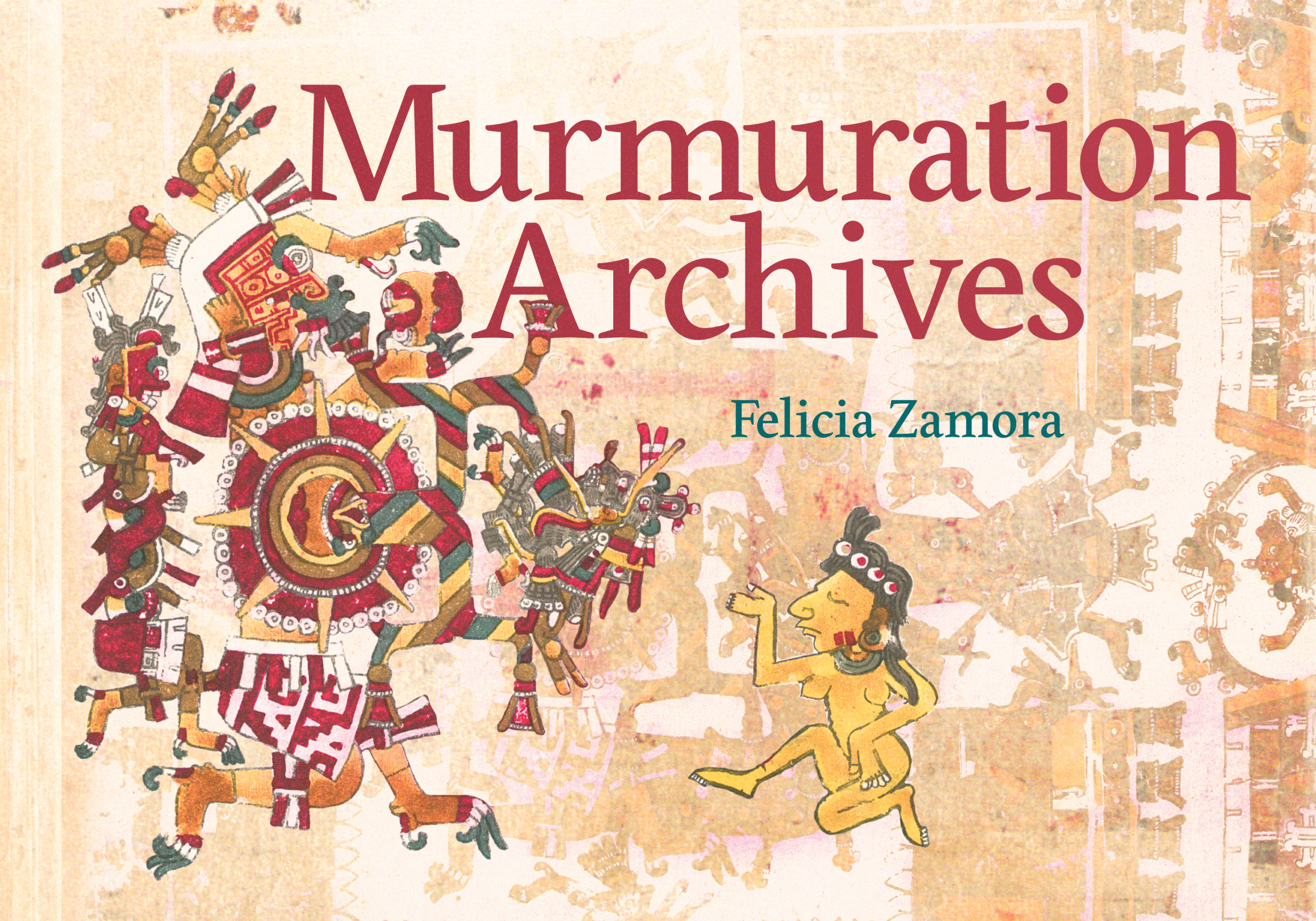
Murmuration Archives
by Felicia Zamora
$22.00
Synopsis
In her bold new collection, Murmuration Archives, Felicia Zamora traverses overlapping orbits of an ancient Mesoamerican codex, lineage, and her stage two breast cancer treatment. “Desire brought me here,” the voice confesses while studying the Codex Yoalli Ehēcatl, one of the only pre-Columbian texts to survive the Spanish colonization of Mexico. Through interactions with the Codex, Zamora’s “undulations” emerge— preverbal, more-than-verbal, urges and responses to the document, while also undergoing surgery, chemotherapy, and radiation. Spanning Chichén Itzá to the Vatican Apostolic Library, to the Popol Vuh, to the exam room, to the Tōnalpōhualli, to the infusion center, to Xibalbá, these poems attune to the ancestral, ontological, anatomical, and environmental gaps left in the wake of violence, to create imaginative bridges of homecoming, belonging, and futurity that wormhole centuries together in a present pulse. Zamora’s poetry reminds us that the body is the first archive, as she melds the rawness of cancer with the empowerment of finding the self in the voices of the ancestors. Docupoems reveal the body as a site of channeling, site of liberation, and site of occupancy where ruins, joy, lineage, illegibility, grief, and disease live restlessly intertwined. “Reminders how the body sings despite.” Murmuration Archives is a love poem to descendants of ancient Mesoamerica and cancer survivors—illuminating the primordial collective inside each of us.
Blurbs
Felicia Zamora writes about the female body with exacting precision. In Murmuration Archives, wounds are mapped across millenia, traveling past, present and future in ways I never fathomed. Through these dynamic poems I, too, understand that fragmentation is a gift and that desire itself is holy. This is an expansive and necessary collection.
Erika L. Sánchez
author of Crying in the Bathroom: A Memoir
Felicia Zamora’s brilliant book-length collection, Murmuration Archives, combines archival research of an ancient Codex with personal testimony of breast cancer to enact a wondrous and howling narrative of healing, existence, and survival. Spoken from the voice of a poet whose body has endured and traveled far to pay ancestral respects, this book is relentless and searing as much as it is tender and vulnerable. Zamora achieves language that is both meticulous and exquisite alongside impactful visuals that revere the image as its own kind of text. In what becomes a fiery meditation for our fractured times and a salve for the wounds of past, present, and future, Zamora’s poems reach enthralling heights while honoring the revelations of the Codex as document and origin for the cellular and spiritual self.
Mai Der Vang
author of Primordial
Amid stricken lines gray as ashes, a poem concludes: “Something lovely murmurs in the unknowing.” This is Felicia Zamora reckoning with cancer and chemo, those feuding, brutal conquerors. Isolated to the poem, the line reads as a revelation. But. Pages before, there’s Zamora’s staggering “Plaything,” in which the poet—furious, disconsolate—lays bare colonial power’s senseless vandalization of the Nahua’s sacred Codex Yoalli Ehēcatl leaving Zamora’s heritage rent, burnt, unknown. In Murmuration Archives’ implacable chorus, revelation must also be prayer; regeneration, death; a routine physical, a summoning ritual to Huixtocihuatl, whose saltwater surges into a different poem pages and pages later. To inhabit this archive is to be in Zamora’s “tricky god mess” of space and time, “after of Spanish left [Zamora’s] body hollow,” “before Diagnosis,” all “while watching documentaries about ancient Maya civilizations.” Here? Then must also be now, just as what’s murmured must be lovely, must be horrid.
Douglas Kearney
author of I Imagine I Been Science Fiction Always